How to Adapt Jeopardy Rules for Classrooms, Offices, and Events


In our previous post, we covered the official rules of Jeopardy—from how the board works to the wagering mechanics behind Daily Doubles and Final Jeopardy. Those rules are the foundation, but they were designed for a TV studio with three contestants and a professional host.
Real-world Jeopardy looks different. A classroom full of fifth graders, a corporate onboarding session, or a 50-person trivia night each calls for its own adjustments. That’s exactly what Factile was built for—a platform designed around real-world Jeopardy-style play, with features and rule variations that make the game work for almost any group or setting.
Classroom Jeopardy Rules
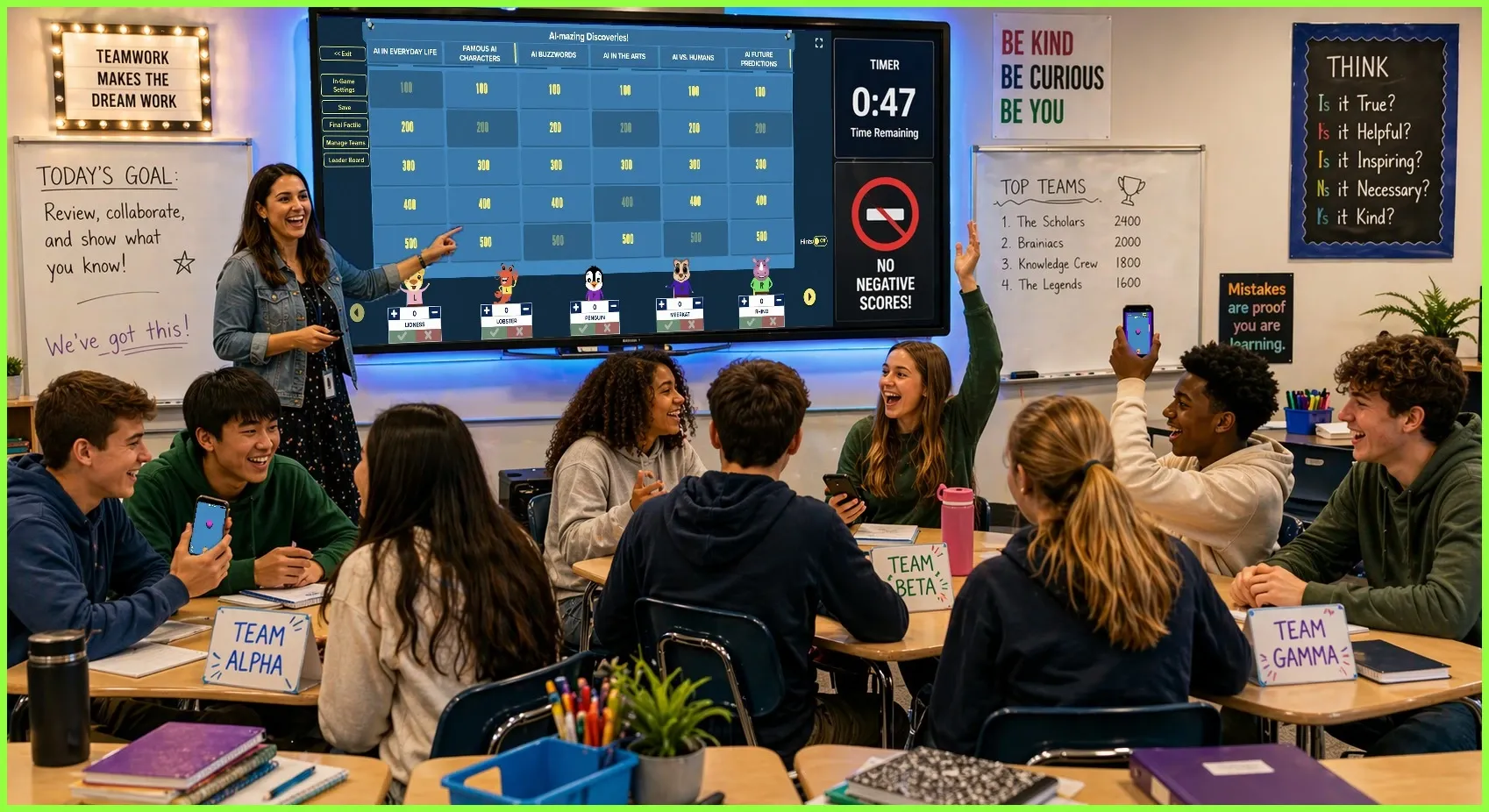
Classroom Jeopardy has a different goal than the TV show. The aim isn’t to find the fastest buzzer in the room but to make sure every student engages with the material. A few simple tweaks make that happen.
- Drop the question format: Most teachers skip the “answer in question form” requirement. Direct questions like “What is the chemical symbol for gold?” are clearer and less confusing, especially for younger students.
- Use Buzzer Mode: Factile’s Buzzer Mode turns phones, tablets, and computers into buzzers, bringing that game-show excitement to topic reviews.
- Try positive-only scoring: Deducting points for wrong answers sometimes silences hesitant students. Positive Score Mode keeps participation high and the atmosphere encouraging.
- Have all teams answer: In classic Jeopardy, the first correct answer advances the game. In the classroom, it’s often better to let every team respond before moving on—Factile’s “Allow Multiple Teams to Answer” setting makes this easy.
- Set a timer: A 20- to 45-second countdown strikes the right balance between thinking time and pressure.
The Daily Double adds a fun moment of choice and is worth keeping if time allows. Final Jeopardy makes a strong closer for a full class period. If you want a quick 20- to 30-minute review, you can skip both. For more ideas on running Jeopardy in the classroom, Factile’s blog is a good place to start.
Trivia Night / Social Event Jeopardy Rules

Trivia nights and social gatherings have their own rhythm, and standard Jeopardy rules don’t always match it. When the goal is a fun night rather than a fierce competition, a few tweaks go a long way.
- Skip the question format: Just like in classroom play, dropping this rule removes a barrier and keeps things moving.
- Try Multiple Choice mode: This works well for groups with a wide range of trivia knowledge. Instead of recalling an answer from scratch, players pick from a set of options, keeping everyone engaged.
- Use Buzzer Mode: Same game-show feel as the classroom setup—players buzz in from their own devices.
For bigger gatherings, Factile supports up to 100 teams per game, with multiple players per team depending on your plan. For more ideas on putting together a great trivia night, check out Factile’s blog.
Office & Corporate Jeopardy Rules

Jeopardy works remarkably well in workplace settings—onboarding sessions, team-building activities, or staff meetings that need a little more energy. That said, standard scoring rules can undermine team morale.
- Use Positive Score Mode: Incorrect answers result in no score change rather than a deduction, keeping the atmosphere encouraging and the focus on learning.
- Try Multiple Choice mode: Same benefit as trivia night—it levels the playing field, which is especially useful for onboarding or training sessions.
- Keep rounds short: Individual rounds of 15 to 20 minutes help maintain energy and fit neatly into a meeting or event schedule.
Use Question Banks: Add up to 300 questions to a Question Bank and then generate a new game for each onboarding session. The games never get stale.
For trade shows or science fairs where you want to showcase topics and facilitate repeated game plays, try Factile’s Event / Loop Mode. You can also use Double Factile Plus to sequence multiple games back-to-back and carry over scores. For more workplace Jeopardy ideas, check out Factile’s blog.
Remote & Hybrid Jeopardy Rules
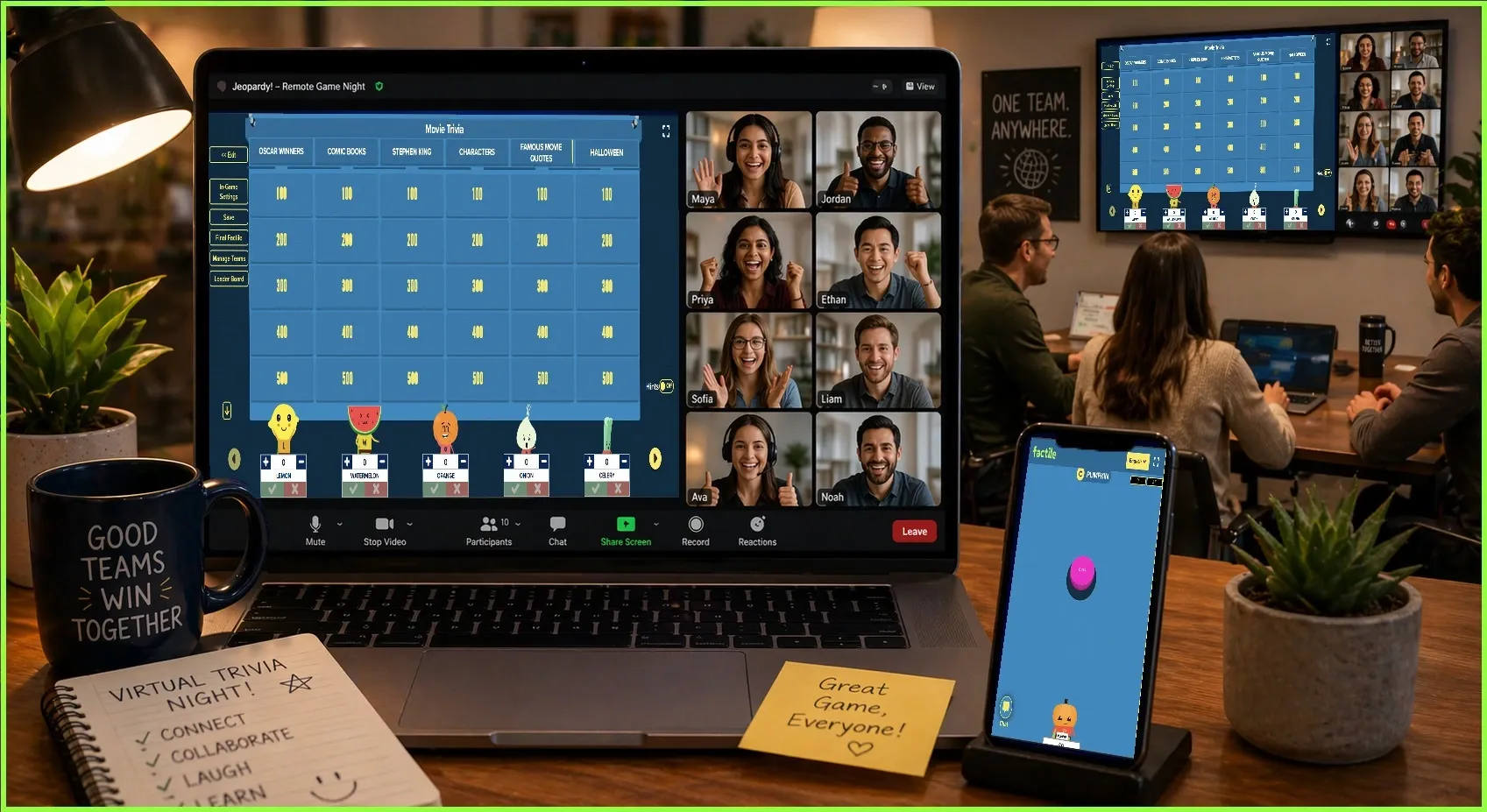
Playing Jeopardy remotely comes with unique challenges, but the right setup makes it just as engaging.
- Share your screen on any video platform: Factile works seamlessly via screen sharing with Zoom, Microsoft Teams, Google Meet, Webex, and Skype. The host shares their screen and runs the game as usual.
- Use Remote Buzzer Mode: Every player’s phone, tablet, or computer becomes a virtual buzzer—keeping the competitive element intact no matter where players are.
- Keep hybrid play fair: For settings where some players are in the room and others are remote, Remote Buzzer Mode ensures everyone buzzes in on equal footing.
- Lean on engagement features: Leaderboards, sound effects, and team mascots help sustain energy—which matters more when the natural buzz of a live room isn’t there.
How to Set Your Timers
One of the most common questions when running a Jeopardy game is how much time to give players. The answer depends on the complexity of your questions. Here’s a quick reference:
| Question Complexity | Reading Timer | Answer Timer | Best For |
|---|
| Quick facts | ~4 seconds | ~12 seconds | Fast-paced review, warm-ups |
| Moderate | ~10 seconds | ~25 seconds | Standard classroom or office play |
| Deep thinking | ~15 seconds | ~40 seconds | Multi-step problems, discussion-based |
The reading timer controls how long players have to read the clue before the buzzer activates. The answer timer is how long they have to respond after buzzing in. Factile lets you configure both independently.
Quick Comparison: Rule Variations at a Glance
Not sure how your setting stacks up against the classic format? Here is a side-by-side look at how the rules shift from the original TV show to real-world play.
| Original Jeopardy | Classroom | Trivia Night | Office / Corporate | Remote / Hybrid |
|---|
| Typical Audience | Adults (general) | Kids – Students | Adults (mixed) | Adults (colleagues) | Any |
| Vibe | Competitive | Review & practice | Casual & fun | Review & practice | Varies by group |
| Players | 3 individuals | Teams of 5–40. 10–100 for tournaments | Flexible, up to 100 teams | Teams of 5–20. 10–100 for conferences | Flexible, up to 100 teams |
| Scoring Mode | Standard deduction | Generally Positive | Standard or positive | Positive-only recommended | Standard or positive |
| Question Format | Must be in question form | Direct Q&A | Relaxed | Direct Q&A | Relaxed |
| How Teams Answer | Individual buzzer | All teams or first 5 for tournaments | Buzzers | All teams or only first for conferences | Remote Buzzer Mode |
| Timer | Strict | 12–40 seconds | 15–30 seconds | 20–30 seconds | Flexible |
| Special Features | Daily Double, Final Jeopardy | Daily Double, Final Jeopardy optional | Daily Double, Final Jeopardy | Event Mode, Double Factile Plus | Screen sharing, Remote Buzzer Mode |
Your Next Jeopardy Game Starts Here
Jeopardy is one of those rare game formats that works just about anywhere—a classroom review, a staff meeting, a trivia night, or a remote team hangout. The right set of rules makes all the difference between a game that falls flat and one that people are still talking about the next day.
With platforms like Factile, adapting those rules to your setting is less about logistics and more about deciding how much fun you want to have with it. Features like AutoGen AI, Buzzer Mode, Multiple Choice, Event Mode, and Double Factile Plus are all built in, giving you the flexibility to make Jeopardy work for any group.